
Creating The World's First Meditation App w/ Andrew Johnson
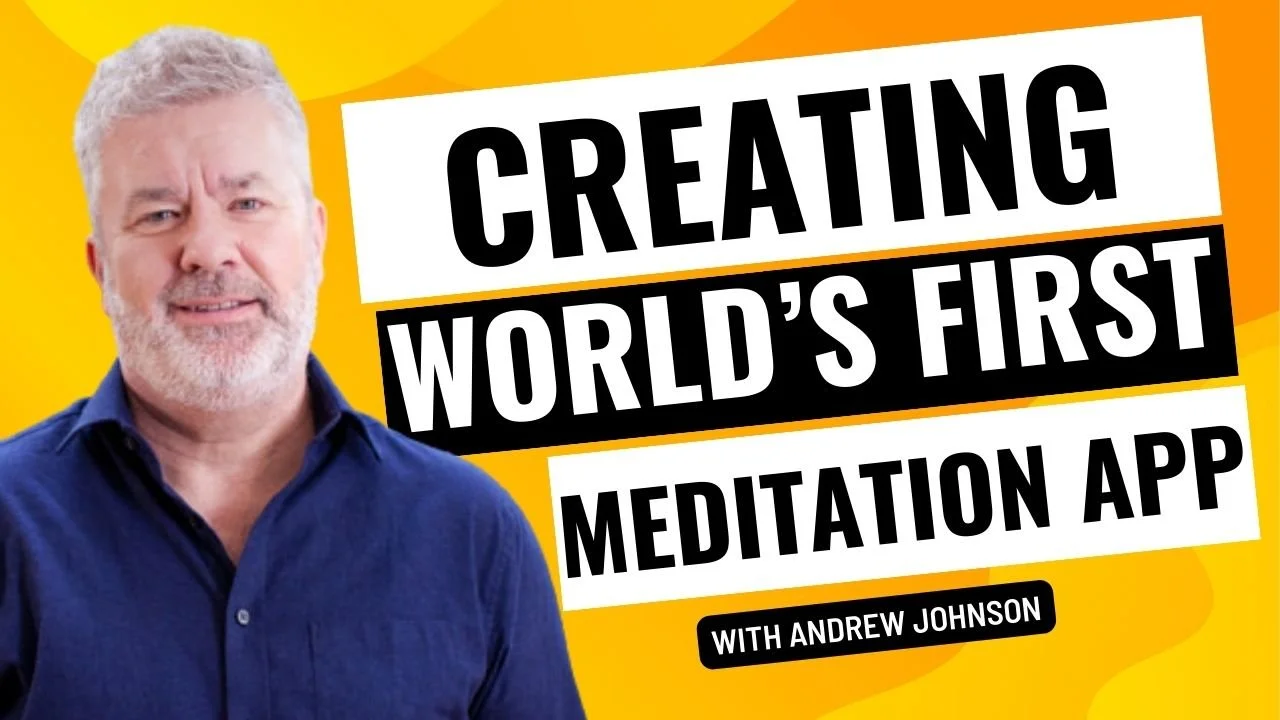
Andrew Johnson is a meditation pioneer, who created the world's first meditation app in 2009. In this episode, we talk about the differences between hypnotherapy and guided meditation, as well as how Andrew comes up with new ideas for meditation. Andrew also explains how to decide what channels to distribute his content on.
GIFT FOR YOU
If you’re a meditation teacher or coach who wants to create unique meditations people listen to over and over again, enroll in my free course Meditation Script Mastery
Music Credit: Nova by River Roots - https://www.youtube.com/riverroots
Podcast Transcript
Lou: Welcome everyone, to the Art and Business of Meditation podcast. Today's episode, we have another special guest. I cannot wait to speak with our guest, Andrew Johnson. For over 26 years, Andrew has been helping people relax, change and create the lives they want through his range of self care recordings, guided meditations, apps, online courses and workshops. In 2009, get this, Andrew released the world's first meditation app and is now his life's work is curated in his latest app, Relax, Change, Create meditation. With over 19 million downloads and streams to date, Andrew's recordings have motivated and empowered people to cope with stress, overcome anxiety or fears, break habits and achieve their full potential. Andrew, welcome to the show.
Andrew: No, thank you, Lou. I'm really happy to be here. Thanks for the invite.
Lou: Yeah. So Andrew, you are an OG in the space. You've been creating guided meditations for nearly as long as I've been alive. And you've been meditating.
Andrew: Please, am I that old?
Lou: 33, I think you've been creating meditations for 25 years. So that's a, that's a good amount of time. You've been meditating, it sounds like longer than I've been alive. So I just, I love to hear where meditation enters your life. What's happening at that time? What does it do for you? Just take us back there a little bit.
Andrew: Oh my goodness. Well, I've told this story so many times. So I was born and brought up in Glasgow in Scotland and in this mid-70s, that's how long ago it was, folks. I, I, I like many people who started getting interested in martial arts. There was programs on the television at the moment, David or At that time, David Carradine doing a program called Kung Fu, Bruce Lee, Enter the Dragon. There was so much interest in martial arts and I, like many of my teenage friends at that point, wanted to learn. And I went along to an after school class to learn some very basic karate and I really mean basic karate. But at the end of every class, and I guess I was about 15, at the end of every class, the teacher would take us through a little meditation. And I remember this so vividly. I remember sitting there and listening to my friends giggling as this teacher took us through these tiny, very basic exercises. But I remember sitting there and thinking, this is actually, this is interesting, this is quite nice. Now at the same time my father had introduced me to many books which at that point were all about sales and the power of positive thinking. So the, the Magic of Thinking Big, Think and Grow Rich books like that, the classic books from the 30s and I've read them and digested them and started thinking there is a real power to the mind here. And I started what I now look back on as a very, very basic meditation practice which was literally just sitting on my bed, back against the wall, cross legged and just being quiet. And I can't put into words what it did to me, I can't really remember. But I think at that point it just grounded me. And so I had that sort of on and off incredibly basic meditation practice for many years through my teen years, through my twenties. And I had a variety of careers that although that brought in what I was looking for at that point, a little bit of money and social standing, I was always looking for something that would put me into career that involved the mind and helping people. And so in the early 90s I started looking really seriously at this when I was in my very early 30s. So there you go, your age. And I found an 18 month course in clinical and medical hypnotherapy, which was a sort of regulated course that I could do in Scotland that gave me a diploma in clinical and medical hypnotherapy that allowed me to become after the course of therapist. But after the first couple of weeks of training I started thinking, my God, this is just what I've been doing by myself. This is, this trance state is a meditative state. And that got me really interested in the link between relaxation, stress management, hypnotherapy or what we would call trance and meditation. And I threw myself into it, I absolutely threw myself into it and started working with clients and I think 95 and I was seeing people for confidence building, stop smoking, stress management. And I, I started having a relatively okay private practice and it sort of went on from there. So that was about 95, I guess. I was 34 at that point and I just loved it. It was never about money, it was never about anything else. It was about doing something special to help people. And I absolutely adored it. So from there, one of my mentors on the hypnotherapy course, because I went back and did another two additional courses, but as a supervisor and one of my mentors said to me, the best thing you can do, Andrew, is go and volunteer for a charity. Go and give your services to a charity. Because what you will really get then is instead of people coming along for stopping smoking or biting their nails or spider phobia, what you will really get is people who have, there are, there are issues with stopping smoking and spider phobias and biting your nails. Of course there are, but you will get people who have got really deep challenges in life. So I, I very quickly found a position in a, in a cancer charity and I worked there part time for two years. And in doing that, I discovered a love of doing classes. And I would be teaching what I then called, and started off calling self hypnosis, which in turn then just broadened slightly, deeply to relaxation practices, which then with the same class, after three or four months of seeing the same class, became a meditation class. So it was teaching the people how to relax, how to take control of the thoughts, and then giving them the tools that they themselves could find their own meditation practice. So that was the early part of my career and certainly when people have asked me, as they've gone into therapy or meditation practice before, what's the best thing I can do? I will say to them, try and find a charity that needs your services and slowly just gently introduce all these wonderful techniques to them.
Lou: That's amazing. That's actually something I've not heard and have not thought about. I mean, we talk about like, where to get started and it's always, you know, reach out to yoga studios or, you know, start to build online. Start to. For me, I, I created a meetup group, meetup.com and I had people just come and I was leading meditation with people. But to find a charity is a really interesting and beautiful thing that, that I, I hadn't even thought about. So I, I appreciate that.
Andrew: Well, of course. And again, this is the mid to late 90s and meditation is nothing like you and I both experience now. It's a bit, in those days Especially in Scotland, it's a bit woo woo, it's a bit out there, it's a bit strange. But I think because of the way that I introduced it, where people get used to the internal state, the stillness and the quietness, and allow, I, I hope that I allowed the people at that, in those classes to discover meditation the same way that I did, to introduce it gently and easily with no great woo woo attached and allow people to discover the benefits for themselves. Because it does take a little while before people start to think, actually, do you know something? This is, I don't, I can't put my finger on it. I just know that this is beneficial.
Lou: Reminds me of like the dent, The Dan Harris 10% happier of just, you know, maybe for some people, meditation it can be this radical shift in being. Sometimes you might have those experiences, but you know, also it's just this kind of consistent build. And it sounds like that was maybe even your experience growing up as a teenager. Like it was you, you stayed connected to it, it was helpful. And then it was maybe a realization of, okay, I want to help people more. And then this opportunity in hypnotherapy came.
Andrew: Yeah. And I think it has been proven time and time again to me over the years, the decades that I've been doing this, that the people who could really benefit from going within, most of them are the people who shy away from it, who back away from it at first. And that's why the gentle approach, the simplistic approach, the, the introducing it with a, with a little bit of gentleness and a sense of humor and just what, what one of my lecturers, the university, would call the salami approach, it's just a little slice. How do, how do you like that? Is that okay? Yes. Well, let's do a little bit more and let's introduce a little bit more. And before they know it, they are discovering within themselves the positive benefits, all of which are different for everyone.
Lou: So I love to hear, as someone who's not a hypnotherapist and does a lot of guided meditations, which I'm sure there is something that I might be missing, of course, but I'm curious, what are, are you holding different hats when you're leading people? I don't know if you do one on one sessions anymore, but when you're doing hypnotherapy versus when you're doing guided meditation, like how close is that line? And maybe what are the differences that you're holding in your mind as you, as you do both sure.
Andrew: Well, I stopped seeing clients because of the success of the recordings. I stopped seeing clients about. I did one to one clients for about 17 years. And when people come in for a hypnotherapy session, you are of course working on a very specific subject. So you are taking case study and asking questions and building what you talk about in the session on the answers that that person gives you. Now a hypnotherapy session is built into a few sections. First of all, there is the induction and then the therapy and then the. The post hypnotic suggestions and the awakening session. The induction itself is to the most part progressive relaxation. So just going through the. It's like a body scan, a simple body scan, because you find that when most people come in to see a hypnotherapist, they will be A nervous because they've never had it before and B unsure about sitting for 40 minutes with their eyes closed. And C, they will have never had any experience of eyes closed work before. And so the skill of a hypnotherapist and the main to start off with is the ability to take them very slowly, no matter what their sort of status, to take them slowly down into what you and I would call meditation, what in hypnotherapy we call trance. And it is once they are down in that meditative state, I would then do a session based on their answers about how they wanted to change their viewpoint externally and internally, about what habits they wanted to break, about what habits they wanted to create, about how they wanted to be after the session. Now there is a. It's like one of those Venn diagrams, isn't it, where you've got hypnotherapy, you've got meditation, and in the middle there's this state that we go into when we're sitting eyes closed. And there is this real gray area between hypnotherapy and meditation where if you are doing a guided meditation for someone and you're wanting them to access a part of themselves, like an inner guide or an inner child or a part of them that needs a confidence boost, which we can do in meditation, then is that meditation or is that hypnotherapy or is it just a crossover? Now there are certain things that I would see a specifically hypnotherapy like some deep pain control and some regression, childhood regression or past life regression. But in the main there is this, there's this crossover between hypnotherapy and meditation. Meditation in my view is letting the person involved access their inner state without too much guidance from the teacher, allowing them to just find their own way of doing things to teach them the way to actually do it. Whereas hypnotherapy is. It's a lot more, I wouldn't say authoritarian because it is in fact actually quite gentle. And for anyone who's listening to this and who's thought about hypnotherapy, it is very gentle. And although it's more authoritarian than meditation, you cannot make anyone do anything that they don't want to do. Far from it. The biggest client base that hypnotherapists have, well, it used to be when I was working was stopping smoking. It's changed now because of. There are less smokers. But I would have people come along to see me and they would. You could tell that they just wanted to stop. But occasionally you'd get someone who would come in and say, my life wants me to stop. And I would say to you, and, well, not really. And I say, well, I can't help you. I can't help you. And as I've said to many people who know what I do for a living over the years, and they say, well, you can make people do things. To which my answer is, well, I. If I could make people lose weight, I would be richer than Elon Musk. I would be the richest person in the world. People need to meet you halfway. So hypnotherapy is more about a directed, specific guidance based on their answers to questions. And meditation is much more general. But in the long term, meditation gives people a huge amount more power.
Lou: Interesting for discovery.
Andrew: Assuming people practice and have that ongoing.
Lou: Learning journey because they're going on their own experience, they're really looking for their own nature in that process. If it's guided in that way with spaciousness. Yes, more heavily guided, you're looking more in a hypnotherapy. I'm just curious if someone's creating guided meditations as listening to this and is wanting to be careful, right. If they're going. They're wanting to be safe, Right. They don't want to lead people to some place where they don't feel confident. You know, is there anything that you might say to. To. To not do or to be careful of? Or is it. If you're doing it in a way that's empowering the person is, you know, is it kind of. Yeah, I guess I'll just stop there.
Andrew: I think if. Now I've got some recordings that I would say sway more towards hypnotherapy. Because they're a lot more specific. But in those cases it's important to talk about how safe people are, how that they can stop at any point. Even though I've never had anyone wanting to stop, the vast majority of people in one to one sessions absolutely love it afterwards. And also, and I think this is really important, it's about making instructions general enough that the vast majority of people have some sort of connection with it and not, not inducing them, not taking them down into meditation or trance too quickly. And I see this, I see this a lot where people will say, well take a couple of deep breaths, you know, close your eyes, take a couple of deep breaths. Right, now we'll start work. And the. No, no, I'm not, it's just, I'm not ready yet. So it needs to be slow and gentle.
Lou: So you stopped doing one on one hypnotherapy because your recordings were taking off. Is that during CD times? And how was that? How are you distributing then? I'm just curious at what the opportunities were back then that maybe are a little different now.
Andrew: Oh my goodness. Right. So as a hypnotherapist you give everyone a recording to take away the belt and braces approach. So when someone comes for stopping smoking, you give them a stop smoking recording, which by its very nature is a version of the recording, but more general. And again with, again talking about smokers, the vast majority of smokers have the same habitual behaviors. So you can have a general recording, people with insomnia can take away a deep sleep recording, etc. Etc. So very early on in my career, because of the necessity of that, I started doing very basic recordings on cassette, which you may not. Do you even know what a cassette is?
Lou: I know what a cassette is. I listen to some, some Michael Jackson in my mom's car. I remember that.
Andrew: Yeah, well, you see the thing is I spoke to someone the other week there and they had no idea what a cassette was. So I'm just checking, I'm just. Technology improved and as computer started to get a little bit more advanced, they started to be sold with CD burners. And I started hearing from people, I don't have a cassette player, but I've got a CD player. So the shift was made into the same recordings digitized and put onto cd. And as the Internet progressed, it then became apparent that I could sell these few recordings. I think I had four or five as MP3s on my website. And as things went on I started mp3s were just at that point available. To download and play in your computer. And I decided, right, okay, I'm going to do something about this business. I know I can sell CDs on the Internet. So I got, instead of doing my own CDs on my CD burner, I got four or five recordings professionally done. So a thousand of each title with nice covers, CD boxes, the whole thing. And the week that those CDs were delivered, I think if memory serves, was the week that Steve jobs announced the MP, the iPod, which was a. In fact, somewhere, somewhere I've still got boxes of these CDs, but that was a big thing for me. That was as a bit of a. A lover of meditation and mindfulness and therapy, and also a bit of a nerd and an Apple fanboy. I realized that technology, technology was changing so quickly that you couldn't invest too much in one format, having been slightly burdened by getting thousands and thousands of CDs professionally done. So after that, as the, the MP3 started gathering pace, I was still seeing clients. I wasn't selling that many CDs. I didn't have the knowledge. MP3 is a bigger partner. I didn't have the knowledge to put them out. But I kept doing more recordings, putting them out as MP3s, and getting great feedback from them. And I knew the recordings were, in the main, pretty popular. And then in I think it was 2007 or early 2008, Steve Jobs announced the iPhone and quite quickly announced the App Store. And it was. The App Store was opening up in America, and six months after that it was going to open up in Europe and the rest of the world. And I, I remember one day getting an email from a chap called Michael Schneider in Seattle. And Michael was a lawyer, or as a lawyer. And he told me this long story about him and his wife having bought my Deep Sleep CD years before and had benefited from it hugely. And he had been doing as a side project some apps for a thing called the Palm Pilot, which was a precursor to smartphones. And he had built incredibly early in the App Store, and I mean literally the first couple of weeks, he had built a little app to change the keyboard in the iPhone from Portrait the Landscape. This is before Apple did it. So he knew he could build little apps. And he reached out to me and said, I do this. I think it could be huge. I like your content. Can we do something? And I thought about it. Previous to that, Lou, I, I, for about a month, I'd been sort of jumping up and down in Scotland thinking, how can I get into the App Store. What can I do for the App Store? How can. And I'd been asking all my techie friends, can you build apps? Can you build apps? And most of them could build websites, but they couldn't build apps. So Mike had told me, I can build apps. I love your content. Shall we do this? And I said, yes, of course. And off it went. So the first app was released. I think it was, I might be wrong in this. I think it was early 2008 rather than 2009. I might be wrong about that. And it was just a lovely relaxation session. And it started ticking away and it started growing and I did another one and added another one and I did another one and we started really getting into it. And at that point, after about a year, I thought, okay, where's my bliss in this? Do I continue seeing one to one clients? Do I continue my charity work or do I put my heart and soul into the recordings and reach so many more people? Because the pricing of it at that point was the CDs used to, let me put this into dollars. If most of your audience are in America, it would probably be about $14 for a CD. When I started doing MP3s, it would be 10 $12 because, well, it's the same content. And then the App Store came out and the price just plummeted. Everyone was selling software and games for a couple of dollars. And I thought, well, this is the way it Is. They were 1.99. And all of a sudden we were getting tens, dozens, hundreds and then thousands of downloads. And I thought, okay, this is what I need to do. I need to, I need to jump in two feet into this and follow my bliss and do the recordings. And that's when I stopped doing one to one sessions. And I still kept up the corporate work, the, the workshops, and I still kept up, kept up at that point the charity stuff and was donating recordings to everyone I could give them to.
Lou: What was the meditation app called? And like what. At what point? Revenue, you said, you know, a couple thousand. So I'm assuming like you're making like maybe four or $5,000 a day, a month. Like what's like the revenue where you're like, once you have meditation app called and then when were you like, okay, I just made 5,000 this month from this thing. If I put all my energy into this, maybe I can go to 10,000. Like, I think it's helpful, especially in this podcast, for people to hear numbers, like when you make these decisions as they're thinking about it in their own life.
Andrew: Well, at that point, at that point, let me think. The app was called Relax with Andrew Johnson. Michael being a lawyer and being in branding and he worked for a lot of tech companies in Seattle, was saying if the app store goes this as big as it it could go, we need to have something that defines us if we don't have a brand. So let's keep the your name in it so that it would be stop smoking with Andrew Johnson and etc. Etc. At that point, let me think if I can remember, I was probably charging $60, $50 an hour, one to one sessions and if I was doing 20 a week, which would be a good week because they're intense, let's say $1,000 a week. So I would imagine if I'm thinking back and although there was MP3 sales and still some CD sales and still some corporate work, it was quite an easy decision at about two or three thousand dollars a month to say, okay, if I put my full focus into this, we can start really going for it and see where we go. And it was a relatively easy decision at that point, Lou, because as I say, I'd done 17 years of it and there comes a point I still love the group work which is my. If I'm working with live in front of people, it's group work that gives me the greatest joy rather than a one to one session.
Lou: So you clearly have an incredible skill in creating meditations. And you have, I don't know, you don't know the number I'm imagining thousands of times you've created a meditation. So I'd love to hear how you, your creative process for it. Like how do you come up with ideas for a meditation and what is your process when you're creating it? Do you write it? Do you just get on the mic and just record? And as granular as you want to get from, you know, the type of morning routine you do to whatever, like feel free to get as, as granular on this process as possible because again, I think it's helpful for, for people to hear the details of, of, of a creative process, especially when it's in this very niche topic.
Andrew: Okay, well, in the early days, of course, after 17 years of seeing one to one clients, there are certain specific subjects like confidence and stopping smoking and in some deep sleep that I could have done literally eyes closed as I. And that's only just practice. That's. It's nothing more than practice and using the same techniques and speed of vocalizing the techniques as I would do with anyone that came through the door. And that has stood me in good stead over the years. So I will always. Although I've started in some shorter meditations lately because people have been requesting them. As it started to broaden out, I would start to break down the courses that I was doing in a corporate setting or the meditation classes that I was doing in a. In a group setting, where I would always ask people, what would you like to do next week? Where can. Where can this go? I don't want this to be repetitive, but I don't want to overwhelm you. Where can this go? And people would. And I remember someone saying, well, I'd like to deal with imposter syndrome. And then I would say to the group, anyone else feel that they're an imposter at any point? And 95% of people would put up their hands and you think, okay, this is good. Would anyone like to feel more positive? Would anyone like to, you know, try to combat intrusive thoughts? Would anyone like to be more mindful when the eating. Would anyone like to have a clarity of mind? And so from that would come a range of recordings that I would then start to flesh out. Now, if something was beyond my knowledge at that point, I would get someone to write the script for me. So again, cards on the table. I am not someone who can sit down and write a script. It is not in my nature, it's not part of my skill set. I start with a blank page, I'm stuck. But I would ask someone to write a script and I would have two or three people, some in America, one in Australia, who would write scripts for me. I would get the script and from that script, I would rewrite it for me and probably the end result would be 95% different. But because I had the framework for it, I would then create my own. So that's what I've been doing for the last 10 years. So I would imagine if anyone has written a script for me and then listens to it on one of the platforms, will think, that's not what I wrote. That's. There's not one work there that is from me. But for me, that's the easiest thing for me to do. Now, the only other way that I could do do it is with a group. And I don't see many groups these days. In fact, I haven't seen groups for a couple of years. But the only other way I could do it is be with a familiar group, take them down into a meditative state and Then allow it to flow. And when that happens, it comes through. But that, as I'm sure you and your listeners will probably agree with, is not something you can force.
Lou: Not at all. I love it. It's a great way to think about it. You don't actually, what I'm hearing from you is very often we don't have to come up necessarily with the ideas that it is something in whoever you're working with. If you do have opportunities that you're working with people asking your audience, asking your people, what are they wanting, what are they needing and getting out of the paralysis of a blank page. And nowadays there's tools like a chat GPT where you could say, hey, start me with this meditation around self confidence, you know, see what it turns out. And then maybe if it helps you to just get like, oh, you just got to get momentum and then you get to change the whole thing. So that's great. I love, I love it.
Andrew: It's the catalyst loop. It has to be you, it has to be your words. Yes, it has to be the teacher's words. But that doesn't mean that you can't have a framework to grow on. Whether it's chat GPT, whether it's someone writing a script, whether it's, you know, as I said in my early days, looking through scripts from the huge amount of information we got from the course, but just changing it into a more meditative frame rather than a hypnotherapy frame. And again, and this is perhaps I should have said this earlier, hypnotherapy is very much needing to be done in a one to one basis because what you're doing is you're following and you're pacing. So you're doing a lot of your wording and the pacing of what you're saying based on how the person in the chair opposite is reacting. So you're mimicking, following, pacing, their breathing. You're reacting to the depth of the level of trance that they're in. You're changing the subject matter depending on their reaction and how they look at the time. Meditation is, as I said earlier, a lot more gentle, a lot more general. What you're giving people is the tools to discover themselves. It's all internal for them.
Lou: Someone just starting out on their meditation, teaching, creating, sharing, leading, journey, would you suggest they get a hypnotherapy certification? Should they start on insight timer? Should they sounds like, maybe join a charity? Like, how do you think about, if you ever are asked this? Or think about someone starting out on their journey. And I know that's a broad question, but I keep it broad intentionally.
Andrew: Well, I never thought that doing a hypnotherapy diploma would lead me to where I am at the moment. But what I would say is if it's something that fascinates you, absolutely go for it. It's incredible. It is, it is. If you do the training properly with a proper accredited organization, it's a big time investment, it's a big money investment, it's a big emotional investment. It will change your life. 90% of people will change, hugely, positively. But the only thing that really counts, sitting down in front of people and working with people, whether it's hypnotherapy, mindfulness or meditation. And that's where you need to go out and find your hungry crowd. You need to find the people who will sit down with you. And in many ways, again, talking about the charity work, there is a, there is a way that charities certainly here they work where I went in and I, I said I will do, I'm a hypnotherapist and I don't know about that, but what else can you do? And I can say, well, I can teach people how to relax. Perfect, absolutely perfect. And so you will get people who have never experienced it before, who maybe as individuals would not have looked for it, driven their car to someplace, paid money to go. And so, but you, because it's a charity and they're being advised to do it and it's free, they will come in as a group. And as long as you don't, and again, you don't make it too woo woo, and you don't, you don't take yourself too seriously and you allow people to laugh and relax and you take things slowly, they will then discover the absolute beauty. Oh, and I think the most important thing certainly for relaxation, stress management and to a degree, mindfulness and meditation, as long as you make sure that the people who you're working with know that it's not you that's doing it to them, but rather they are allowing it to happen for themselves. And the people who get that are the people who hopefully will then go on and start practicing at home. And that's where the true magic happens.
Lou: What I'm hearing, that is a real kind of empowered stance, right? That it's, you're not, you know, changing, you're not manipulating that people are getting to have their own experience and that's really where that will continue them on whatever the journey is, whatever they want to learn more at you know, something, something you, you've said a few times, your bliss. And I'm imagining it's a Joseph Campbell following, following your bliss. And so I want to just put a point on that and what I'm hearing you say also to, to. To. In some, in not exact words, but to people starting out to, to follow their bliss in a way, wherever that's leading, Leading them.
Andrew: Yes, I had a little epiphany and, and, and I had, as I said before, the hypnotherapy. I had done a variety of different careers, none of which I was happy with, but you do it. You just do it. And I continue to engross myself in positive mental attitude and put up little posters in my room and, and read about so many things. I mean, one of the big books that changed me so many years ago, the very late 80s or early 90s, was the Celestine Prophecy. I think an awful lot of people find that as an introduction to energetic work and, and, and viewing the world in a different way. And I remember thinking, what am I going to do? And I, I remember glancing up at a poster that I'd written years, or I printed out years ago, and I think it's Mark Twain. And it said, the secret of success is to make your vacation your vocation. And I thought, what do I do for joy? What do I do? And I'm looking at all these books, Course in Miracles and the Celestine Prophecy and so, so many of these amazing, amazing books that I hope we, most people have read and think and looking at books like Cyber Cybernetics and the Power of the Unconscious Mind and thinking, this is what I do. This is what I do for joy. How can I change that into a vocation? How can I make this shift into helping people deal with mental health and relaxation and stress management and, and phobias. And a couple of weeks later, as soon as you make the decision, of course, as it says that so many people will say as soon as you, as soon as you commit to something, the doors in front of you will open. The universe will put you on the leading edge. You start to see things coming towards you and you think, now how didn't I see this before? But it's because you've made that energetic shift and you just see it and you think, this is just perfect. And when I started the hypnotherapy course, there was 46 people in the class at that point. And I remember one of the lecturers said at the start, there's 46 of you here. Today there's probably three or four that will make a career at this. And I was like, yes. And that. That was. It was. And sometimes I think this is a bit of a problem in life and I wonder if your listeners will agree with me on this. There are certain things that the decision to do it is so easy and so natural that it becomes more difficult with other decisions. Will I do this or will I do that? Because when you get that little epiphany of this is what I should do, it's as if everything else drops away and there's nothing that's going to stand in your way. This is right. This is what I'm going to do. I gave up a good job and a pension and a company car and everything. And I, I moved from a. A house that I owned into a bed set and I just worked. I just worked and worked. So. And it was, it was completely joyful, completely blissful.
Lou: Make your vacation your vocation. I don't know if I've heard that before. I love it. Do you have something that you failed at and maybe a lesson to share? A course you launched that didn't work out? I'm assuming, obviously the app would have had to have ended at some point. Is there something that sticks out that maybe you kind of learned from?
Andrew: Well, I think talking about earlier, I think you need to go with your gut. It would have been so easy having a random email from Mike had. I thought no, but my gut was telling me something else and that led to an absolute, complete 180, 360 degree shift in business.
Andrew: The app is still available. It's in a different format now. I had to take over the apps when Mike wanted to carry on with his legal decree practice and I took over all the apps four or five years ago. We now get 24 apps and single subject apps and the subscription app, which is Relax Change Freed. What I would say to people is you just got to look for every opportunity. You mentioned Insight Timer earlier. I put recordings. I think I've been on Insight Timer about the same length of time as you. I about. But I had a ton of recordings to start with and I think at that point I was putting on recordings onto Insight Timer, not. I think that was before they were monetizing. There was no, there was no income derived from it. I just did it. So my advice to people would be watch out for technological changes and how you deliver your recordings. I think we're fine with iPhones at the moment, but AR and VR, well, they're on the Horizon, I would say to recognize. I think this is hugely important, that when you're in this business of meditation and mindfulness and you have mentors and peers and students, that we start to believe everyone does meditation. Especially because of the huge increase in the interest with Headspace and Calm and Insight Timer. If you believe that there is nothing you can do because there's so many huge platforms out there now, don't be ridiculous. We are still in the early days of this. It is only a tiny percentage of people who are meditating and being mindful. There is a massive scope for finding your own voice, for getting out there. I think that authenticity is hugely important. I think that. And without blowing my trumpet too much, I think one of the things that's given me a bit of longevity is the fact that when I go into the recording studio and do a session, I still believe and pretend and imagine that I'm talking to one person. And I think that helps. I also think that many people, and I've been guilty of this in the past, many people will sanitize the recordings too much. There has to be humanity in them. You don't want dogs barking and fire engines going past. But if there is a swallowing sound, which you get when you get into trance or meditation, if there is breathing, that's just you, then maybe leave it as human as you can. And I think people find the balance for that. I went through a phase of it, two years of recording, and every time I said a word, my jaw would click. And it was just the. The most horrific thing I had. I remember doing recordings for about 40 minutes, holding my jawbone so it wouldn't click. Also, be aware that as you start out, if you're starting out in this journey, be aware that there will always be people who may not like what you do. And if you're lucky, you will have a high majority of people who really like what you do. In the early days, from the first app. First. Yeah, the first app came out before the App Store was available in the uk and I wanted to read reviews and I was so excited. I think we were doing about $30 a day or something like that. Of course, Apple take 30% and then that was split halfway between Mike and I. I was so excited, so excited. And I remember on itunes having to finding out that I could read the reviews. I had to sign out of I iTunes UK and sign into iTunes. I think this is right, USA where you could see the apps. I think they were bundled in itunes at that point. And the very first time really excitedly. Absolutely. So excited to read reviews. The first review I read, and I've said this so many times to folk, the first review I read said, lovely, relaxing music, only spoiled by the idiot talking over it. Now, here we are. Here we are. We are. We are. How long? 15, 16 years after that, I can tell you that for weeks, possibly months. Oh, my God. And you can read all the good reviews, but that's the one that sticks out. So when people say, this isn't long enough, and you think, I'll make a longer one, you will find that if you take that away and look at the reviews, people will say, this is the perfect length. And when people say, I don't like this background music, hopefully the majority of people say, I like this background music. You can't please all the people all the time. As long as you're authentic, as long as you take it slow, as long as you put your heart and soul and your, your, your, Your love into it, as long as you record believing you're speaking to one person. Person, as long as you leave the humanity in the recording rather than synthesize it and take all the, the blips and bleeps out, then people will, you will find your audience. And it's not too late. It's not too late for, for anyone to get into this business. The, the other thing I'd like to say is something that my mentor said to me years ago. If you do this for love, you would make money. And if you do it for money, you won't love it. And the secret is to find the balance, to value yourself without losing the love for it. And so many people in this industry because they believe and I, I'm guilty of this, and I have been and I still am at a certain point. They believe that all they are doing is talking to folk. And especially now with home recording, we can record something relatively quickly, relatively cheaply, very high quality with good microphones, and they just want to give it away from nothing. And one of the most important quotes I've ever come across was from, I think it's Conversations with God by Neale Donald Walsh. But one or two, and it hit me like a thunderbolt. And the sentence in that book was, how can you expect anyone to put value on something that you yourself have put no value on? And that's a difficult thing to go over. It's a difficult thing for people who believe they've got a gift, who believes that they want to help humanity, who believe that they want to reach the biggest audience. It's a difficult thing to say. Also, this is a monetary value and I've given my love and my dedication and they're my years to learn this. So that's a big, important one.
Lou: I'd love, if you're listening to this, to just rewind the last six minutes or so and listen to Andrew say everything he just said again, because there was so much, so much wisdom and value and I was just talking with. You would know more than I would know of how early we are in this thing, in this mindfulness revolution. It feels mainstream, but it's only a cusp of mainstream of where it potentially could go. So that's just really important. So many gems in there, so I'd love to hear. I know we have a few minutes left.
Andrew: You're okay for time? Yeah, sure.
Lou: So you have one YouTube video and it has, I think, almost 400 or 350,000 plays. I think. You think you released it like 12 years ago. And it just, it's funny thinking about someone who might start their YouTube channel now and imagine putting their first video and it gets like 300,000 plays. But it sounds like you've been strategic in that you don't put stuff on YouTube because maybe you've put stuff. You're focused so many, so much on these apps. If I'm correct, are you still using Soundwise to host your app for, for your music library? And for those that don't know, Soundwise is a. An app that will host audio recording. So it's a really cool, interesting app. So if you're interested in creating your own app, and I think that's where my question is going, like, for people now, when did you, when did you have the audience where creating your own app made sense? Like, was. Is it through an email list that you have, like, the distribution? I'm just knowing, you know, now if I created an own app and like, got off of Insight Timer for me, where most of my meditations come from, there's some other apps that I, that I'm starting to grow on as well. But for someone who's like, I would love to have my own app and be able to take that, like, you know, to have a subscription where people find me, like, was there a time where, okay, I have a 5,000 list email and I. Or, you know, is there. What was the decision and how you were able to make that choice to. And I know you also do stuff on Inside Timer and well, and I also would love to. For this to move into a conversation of one. Are those Revenue streams. Like, do you have like five different places that you're, you're supporting yourself? Because it's really interesting, I think, inspiring for, for me and for other people to see someone who, it sounds like you're really just creating and you're, you're, you're reaching a mass and are able to support yourself through that. So I'm asking like 10 questions at the same time, but I'll, I'll pause here and see what, what comes from that.
Andrew: All right, well, let's, let's talk technical for a while. So in the early days of the App Store, it was like a gold rush. I was incredibly fortunate that I had 50, 50 revenue stream with Michael. He built it, I recorded it. I had a relatively local, relatively small audience at that point, but that gave us a little bit of a boost. There is absolutely no doubt that, that the apps were built well in the early days. There's no doubt that the content was good, but there is absolutely no doubt that the biggest factor was it was the only thing of its type on the App Store, the only thing of its type. We continued that business by releasing single subject apps for three or four years, and then the big boys started coming in headspace, etc. Etc. Etc. We all know the story. It was a decision by Mike and I and we were approached for by venture capitalists a couple of times because content is king and if they see people with good content, they want to come after it. You can build an app, but the content is king. We both decided that if we went down that route, Mike would lose the thing he loved doing, which was the coding, which was his great hobby. And I can't really speak for Mike, but I, I know that's the case, and I would probably have been taken down an avenue that I didn't want to go down. So we kept it as a lifestyle business and off it went. At a certain point, Mike decided that he needed to get back into the legal business and I took over the apps. But before that point, Apple had basically said to us, do not release any more single subject apps. We will not accept them. And the reason they said that simply because apps, as you know, can do a billion things with geolocation and, and there's so many things that you can enclose in an app. And basically what I, what we were building was something that played an MP3. That was it. So they were saying, put it on itunes. Now, we knew therefore that the only way forward was a subscription app, and I knew the only way forward was A subscription app, because Headspace had done it and Cam had done it and then Site Timer had done it. But in order to build a subscription app, for example, the same format as soundwise, guessing 2, 3, $400,000. Guessing at that, because of not only the app and its functionality and its cross platform, but also the back end that supplies the database and everything. Now things are becoming cheaper. But Soundwise came out. I remember seeing it and thinking, oh my God, this is, this is just what I've been looking for. Because not only do they allow people to put their recordings onto an app that works across platform, Amazon, Android and iOS, but for a relatively small fee. Now by relatively, we're talking about what would it be about 5, $6,000 a year? You can have it white labeled. And so my app is based on the Soundwise framework, but it's my own branded app on my own developer accounts. Now that's a bit of a leap if you don't have an audience. And I have to say that the gold rush in the App Store has long gone. If I was to launch my single subject apps now, and if Apple accepted them, even with the branding, even with the recordings, even with the coding, they would be lost, they would be completely lost in the 4 million apps that are out there. The only way you can launch an app nowadays is if you've got a vast audience or a vast budget. And that is what's led to the success of places like Insight Timer who allow people to go onto that platform with no monetary investment and just see how it goes and try to build social networks that will point any audience you have to those recordings. For me, YouTube has been a mixed lesson because it's only audio. I never took it seriously to start with. And there are hundreds, if not thousands of free meditations on YouTube. Is it an avenue to go down? Yes, it is. With longevity, with your own little drips of public publicity in it, with your social networks pointing towards it, you can monetize it. I use background music for a variety of different sources. A lot of.com, there's two companies in particular that I use that I. I get my background music from, personally speaking, and this is probably naivety. On my point, my recordings that I put up there five or six years ago were consistently been taken down because of people putting up copyright infringement. Even though I could prove to YouTube that I had the rights to that music, it just became too much of a hassle. It just became too much of a fight. It wasn't what I needed to concentrate on, but I Think if you can get over that little hurdle and get it out there and use the keywords, some nice branding, some good descriptions, use your social platforms and grow them, point them towards YouTube, it can be relatively lucrative. Also, it needs to be said that I had an awful lot of recordings on the streaming platforms, Apple, well, itunes, Apple Music is now Spotify, Deezer and maybe five or six of them. And that used to be relatively expensive to do. You go through what's called an aggregator. There are many aggregators out there at the moment and what they do is they will, they will take your recordings and they will send them in the format that these streaming platforms need. You get paid fractions of a penny. But given that you can put recordings up relatively quickly and you're patient enough to wait for longevity, that's another revenue stream. Now, five, six, seven years ago, when I was doing this on itunes and Spotify and all the other ones, it was, you were putting them up for a hundred dollars a track. And now because of competition, you can now get unlimited recordings. You can put on Those aggregators for $50 a year in total. So it becomes what we would say in Scotland, a no brainer. It is just something that you put it up there knowing that you're still in control, knowing that you can take them down at any point if the revenue is not there. But this leads me back to what I was saying earlier. We're still in a tiny market, so people will say to me, when you've got the apps, why are you an insight timer that will delete your market? No, no, no, no. There's hundreds of millions of people out there listening. Put them everywhere, Put them everywhere and see what happens. Just gauge it over a couple of years and see what happens and you might be surprised.
Lou: Okay, I apologize. You had two YouTube channels. I'm just finding the. You have an older one, that's Andrew Johnson that had one video, but now you have Relax with Andrew, that has more videos. So, okay, so you have been. You did lean into that.
Andrew: I did lean into it a bit, but I took down the recordings that I put up because of these continual copyright infringements that I was getting. And this is not just me. A lot of people get this.
Lou: What are the two music libraries that you've said you use?
Andrew: The best one that I found is called tunecore. T U N E C O R E tunecore.
Lou: Look them up. Got it. Okay.
Andrew: They will, they will. You can upload a recording to them in the format they request with a cover, which canva can do as you would for Insight Timer. And they will then selectively put it out to every one of the streaming services and there's probably 15 or 20 of them now and you can do that for. I think I might be wrong, but it's something like $50.
Lou: This is an aggregate. This is the aggregator.
Andrew: This is the aggregator.
Lou: Got it.
Andrew: $50 for unlimited releases.
Lou: Unbelievable. This is awesome. I'm checking this out.
Andrew: That's a good one. But you need longevity with that. Now here's the other. And I am aware of your time, so I apologize.
Lou: No, you're great.
Andrew: Here is the other little hiccup with those aggregators. The way that Spotify and itunes and all the other streaming services work in the main and I think it might be changing now, but it's certainly. I've not seen it is that they regard a one track recording, even if it's 30 minutes to be a single, I. E. A one track, a single. So you're getting not only a fraction of something, but it's not even being priced as an album.
Lou: Got it.
Andrew: So my advice to people, and if I was ever good to go back onto the streaming services again, my advice to people would be to make two or three similar tracks and bundle them together. Then it's priced as an album and therefore the fraction of the percentage that you get is priced as an album rather than a single track. If that makes sense.
Lou: Yes. This is fascinating. I'm going to be looking into this more. I had not known of this and then you mentioned where you would get meditation music from. Do you have any resources for that?
Andrew: I can send them to you, but the one that I use, which I love and have been using for years is Silencio. S I L E N C I O. Silencio. Now, I don't know the actual domain name because I've just got it saved somewhere. Silencio. Meditation. If you put that in, you'll find.
Lou: Yeah, yeah, it looks like it is. Silenciomusic.co.uk that's the one. Yep.
Andrew: And that's if. If that's the kind of music that suits you and is, you know, fits with your way of, of working, then I can heartily recommend them and you will get multi level, multi use, multi domain licenses for. I don't know, I think it's $30 for a track which considering you could put on a meditation that's downloaded tens, hundreds, thousands of times, is fantastic.
Lou: Amazing. Super helpful. Okay, Andrew, I think you've created or offered tons of tons of value on here. I'm so happy to have you on. This has been so fun. There's a part of me that's still curious so maybe I'll just follow that curiosity for one more minute because you mentioned having your own app now and obviously you built an audience. I, I are you, I didn't actually look at you on any other socials Besides checking out YouTube and obviously your meditation apps. Like how are you promote, how do you promote your current like library of meditations? Like, is it like, is email list like a solid like you have a solid email list that you get to share it with like so email list.
Andrew: Is a good email list and number one, you will never control your social media because they can change at any point. Your number one goal should be pulling people off of social media and building an email list. Number two, Google Analytics, Apple Analytics, Google Ads, etc. And that's a bit of a dark art and you know you can, you just got to start small and I'm still not sure of it. Social media. About a year to a year and a half ago I completely pulled out of it all. I was aware and this is a personal choice, this is only personal, but I was aware of the mental health issues that are associated with social media and I just pulled out. Now me personally, personally speaking, just me, I can't vouch for anyone else, but after a year I haven't seen any detrimental effect on the business. Now that doesn't mean you don't get an occasional big blip if someone relatively famous notices you, but we're all shouting into the darkness and it has serious mental health problems when we delve into it and we start to believe that it's real and it's far from real.
Lou: Amazing. Thanks so much Andrew. Where do you want to send people to, I'm assuming to check out your app. What are you creating right now? Anything you're excited about, you know, feel free to share it with the audience.
Andrew: Well, my wife and I are just working on many more recordings, courses for Relax Change, create courses for Insight Timer. I worked with another company called Groker G R O K K E R who are mostly video content. I'm very glad they've got me on there because I'm not video orientated when first thing you say is take a deep breath and close your eyes. But they are, they're a great company and always just looking for new adventures. I'm of the age where I need to slow things down but I can't stop. And when I say slow things down, don't be under any illusion that I work hard. This is not hard work. This is love. This is. I worked hard in the early days, but I don't do it anymore. I. I can see that. I work hard. It's just. It's just lovely. But. Yep, as I said earlier, trying to find, for anyone listening, try to find the balance between doing it for love and doing it for money and find that beautiful sweet spot or you don't lose the love for it, but you know your value and it's. You can vary it at any point. And when people come to me for corporate gigs, which is since I moved to Spain, I don't do very many of them now. I was over in London for a. For a gig early part of this year. But when people say, what do you charge? I say, well, I charge a lot less for charities than I do for lawyers. And then I. And then they have a laugh and I say, just give me your budget. And very more often than not, it's more than I. I would have asked for. Yeah, yeah.
Lou: Overcharge. Overcharge the corporate companies and not the.
Andrew: I say that tongue in cheek. Of course.
Lou: Yes, of course. Of course. Of course. I love it. I love it. Andrew, thank you so much. It's been a gift to connect with you more and share the space with you. So deep vows to you and thanks for listening.